It feels strange to come to the end of yet another #Blogmas challenge and Christmas season. But the truth is that I am publishing this a few days after December 25th because Christmas doesn’t really end over here just yet.
Thanks to my Serbian beau, Christmas shall continue through January 7th, with New Year’s Day sandwiched in the middle of the countdown. So we have plenty of merriment to look forward to these next ten days.
Originally, I couldn’t get behind this extended Christmas season. I can only handle so much of Wham on the radio and Christmas decor cluttering my living room. But in the last few years, the custom has begun to grow on me. To keep things fresh-but-still-magical, Aleksa and I begin to put away the Christmas-heavy icons (Santa Claus, Rudolph, Elves, etc) but leave our winter icons remaining (snowflakes, reindeer, cranberries, etc).
Serbian Christmas is like American Christmas in some ways; then again, what is American Christmas? The interpretation relies on one’s heritage. An Italian-American will value holiday customs that are different to a German-American. Unsurprisingly, Serbian-Americans — which is what our hypothetical children would be — have unique customs, too.
(A footnote; this seems to be a point that many Europeans refuse to understand — the difference between nationality and ethnicity — so I fear it must be bemoaned in spite of willful ignorance.)
Serbian Christmas is a hybrid of Christian theology and ancient Slavic customs rooted in pagan traditions. On January 6th, Aleksa and I will burn a Badnjak, or oak branch, to bring good fortune to all. If my bread-starter goes according to plan, we’ll prepare Česnica baked with a hidden coin inside. Rituals focus on nature and family to bring luck into the new year; gift-giving is mostly absent.
Had we been in Serbia this January, we probably would drink mulled wine at the Belgrade Christmas market. We’d walk around Trg Republike and St. Sava Temple admiring the crafts and sweets and lights. And we’d drive up to Aleksa’s grandmother to eat sarma and other hearty foods one frosty afternoon.
Since we won’t be in Belgrade, however, we try to bring those traditions here — utilizing New York City’s versatility to its finest.
We have much to look forward to, but I’ve glanced over the present, haven’t I? What about Connecticut? My family? Aleksa’s mysterious stomach affliction?
Enter part two: Christmas on the Lake. The morning of December 25th, I woke up early to have tea with my mom and my brother (my dad, unfortunately, had to work). We talked about the night’s events, attempting to settle the age-old debate of what to do next Christmas Eve. We’re all itching for a change now that we’re older; we can’t seem to agree on what we want, though.
You see, Italian-Americans make a big fuss out of Christmas Eve. It’s a night of feasting, drinking, and partying. Christmas Day, by comparison, is a pale experience. We don’t do much of anything beyond exchanging gifts and taking naps.
When my mother’s sister had children of her own, however, she started throwing Christmas morning brunches at her house. For the last decade, we’ve gathered there with our family and her husband’s family to seize the day over breakfast foods.
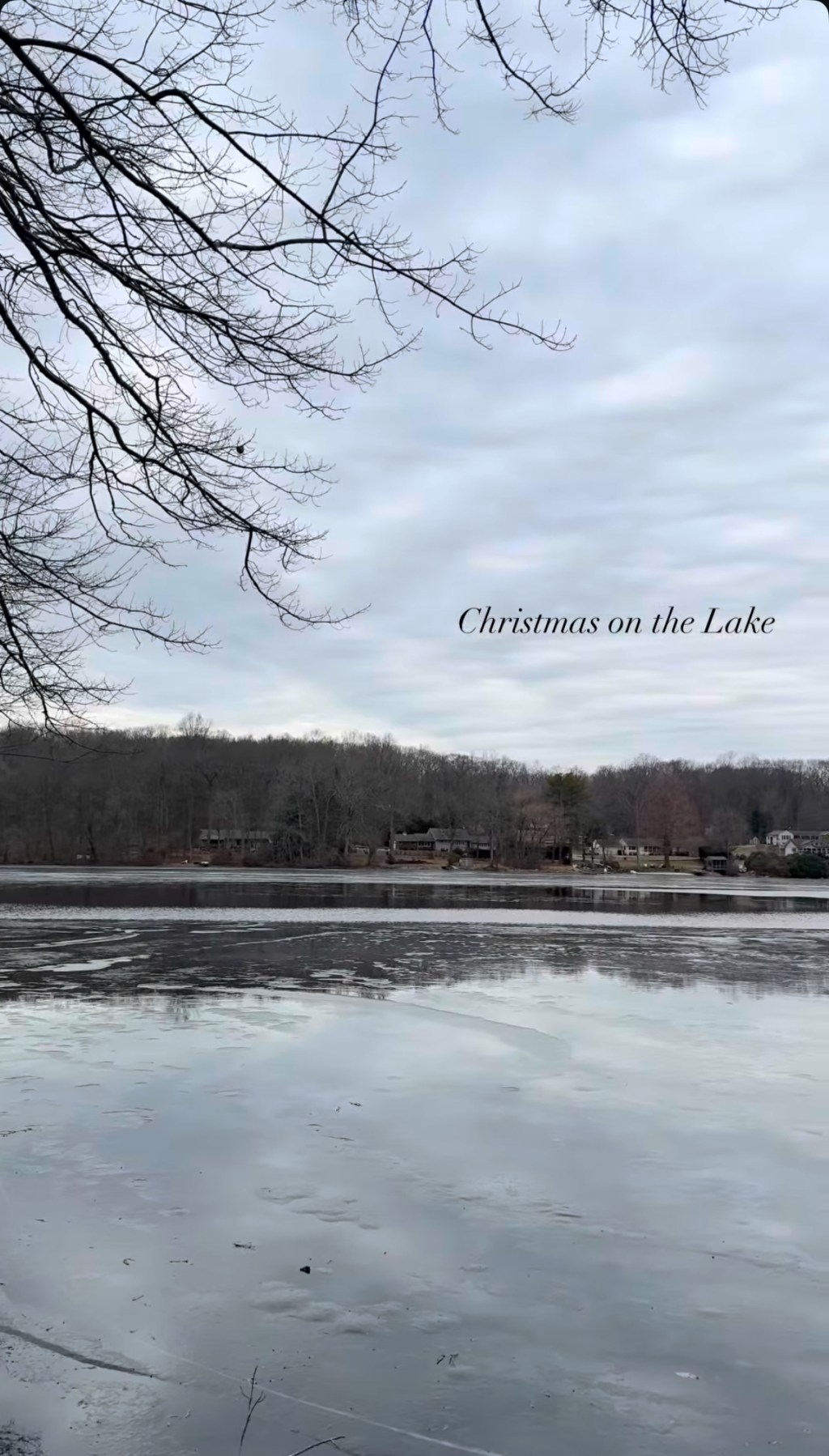
It’s calm, quiet, intimate. My aunt and uncle live in an idyllic house overlooking a lake, surrounded by trees and woodland animals that my little cousins seem to all know by name. The woods are bare, gray; the water is mostly frozen. And the sky is always painfully white, as if snow may fall any moment.
But it’s tradition. So on Christmas morning, after eating bagels and bacon, my brother and I walked down the woodland path toward the lake while the kids ran ahead of us. They were mostly excited about trying out a newly-gifted metal detector from Santa.
We approached the lakefront and took it all in: the gray waters and crisp branches. Hardly a Norman Rockwell, but beautiful nonetheless. My cousin, Jake, dropped a shovel into the shallow part of the icy water. My cousin, Vivian, had to fish it out with a giant stick. Henry and Bow unsuccessfully searched for treasure with their gift. And my brother, somehow managing to bring a cup of coffee along for this excursion, complained about spilling it onto his sweater.
Later, in the house, the kids opened more presents and the adults discussed future Christmas Eve plans. My mom’s brother (hello, Uncle John, if you’re reading this) made a comment that we should all start treating the holidays like a true break from work. “What if we went away? As a family?”
This sparked mild debate: Florida? Greece? How far and how different are we talking? Or do we want something similar to our Connecticut scene —like Cape Cod, Kennebunkport, or Providence?
While our family debriefed, my Uncle John turned to me and said, “the holidays are for kids.” He cut up a piece of ham with a fork and added, “the truth is that if you and Aidan have children, that’s when the holidays will effectively change.” I know what he meant, as it changed for his sister when she had children (who now was hosting a lovely brunch in her home where this conversation could take place in.)
When we left, I considered the truth of his comment. Are the holidays only for kids? Maybe it feels that way when you’re a parent or simply an observer of parents. I guess it definitely felt that way when I was a kid. All year long, I looked forward to the wondrous gifts Santa would bring me and my brother.
On the walk back from the lake, my cousin Vivian asked me, “what’s your favorite part of Christmas?” and surprisingly, I found myself at a loss for words. It was definitely not opening presents anymore, although when did that happen?
“Mine is opening presents,” she claimed, because she is freshly ten-years-old.
“I don’t know,” I said back. “I think spending time with our family. Not having responsibilities for a few days. Eating cookies.”
“My mom made cookies.”
“I look forward to eating them.”
She paused. “So you really don’t like opening presents?’
I tried to explain to her that when you’re an adult, you have adult-money, so you can buy yourself what you want (sometimes). She said “ugh, but I don’t want to work.” And then we moved on to another topic, which is more adult of her than she realizes.
Driving away from my aunt’s house, I held a paper bag full of carbs for Aleksa — who you may have gathered stayed behind at my grandma’s by now. His ill-timed food poisoning was done with, but he was still too weak to rock around the Christmas tree. He urged me to join in on the reindeer games without him — he planned to sleep most of Christmas Day.
I brought him random halves of bagels and muffins on behalf of my aunt’s request. And then I settled onto the floor, wrapping presents we would eventually open the day after Christmas when my father was home from work.
All in all, it was an odd Christmas. I think it might be the most adult I’ve felt at Christmas. The entire time, it was clear to me that I was witnessing my family on the brink of some inevitable change, even if it’s a change I can’t quite grasp yet.
It gives me anxiety, no doubt; holiday movies always feature some plot where the main characters don’t realize that this will be their last “perfect” Christmas. Perfect, in this case, typically means normal. The family together and the spirits bright.
We’re all getting older — even my little cousins — but measuring what I will lose from what has already been lost seems trite and troubling. Instead, I am trying to focus on the positives — on what I will gain. What I can look forward to with the Christmas seasons of my future.
So, until next Christmas, when I will undoubtedly participate in #Blogmas once more … I hope you get everything you want, readers. May your losses be few and your blessings many.
(Oh, and Srećan Božić.)
Sincerely,
That Blogmas Girl
 That American Girl
Leave a comment