It’s no secret that I’m an English professor; I’ve said so a handful of times in older blog posts and across the expanse of my social media.
What might be a secret is the nature of being an adjunct English professor. An adjunct professor is a professor that is hired on a contractual basis rather than being hired for a permanent position. There is a good chance that if you went to college in America, you were mostly taught by adjunct professors. The coveted permanent position is scarce and hard to come by — it is quite fantastical, if I’m being honest. It can take several years of teaching experience and book publications to qualify for such a position. Also, it requires for the position to become available in the first place: a tenured-position is a comfortable, well-paid and rare gig.
As an adjunct professor, I’m typically hired for one semester at a time. The classes are always changing and the schools are always rotating. This past semester I had the fortune of teaching at the Fashion Institute of Technology, Hunter College and Marymount Manhattan College. Next semester could include all of those schools, some of those schools, or none of them at all. I essentially appear where and when I am needed … like Mary Poppins.
Instead of a wondrous umbrella to take me to my employment, however, I am more or less racing around Manhattan in a frazzled frenzy. Think Andie in the beginning of The Devil Wears Prada: the coffee spilling as I chase cabs or hail trains, eventually arriving to the office in an anxious state.
This schedule can be disorienting and frustrating. It’s also pretty easy to neglect one’s social life, if I’m being honest. For me, it felt as though my whole life was school: the cumulation of English offices, classrooms, cafeterias and restrooms measuring up to some kind of MacGyvered mansion at which I lived.
For the Fall 2024 semester, I taught a total of six classes. I learned rather quickly that six classes is too many classes: I’d wake up uncertain about what day it was and where I needed to be, or I’d arrive in a classroom and suddenly worry I was at the wrong school on the wrong day. I had over 100 students with what seemed like 300 assignments to grade every single weekend — essays, homeworks, in-class assignments, or drafts. Not to mention the time that I had to dedicate to planning lessons, answering emails, creating assignments or holding office hours for students. (Also, it was difficult to learn all of their names.)
This was complicated by the fact that I wasn’t teaching unanimous class topics. Collectively, I taught a poetry workshop for seniors, an introduction to creative writing for sophomores, a living authors class, a research paper class for freshmen, and a digital cultures writing class for freshmen. Case and point, my wires were crossed and fried.
On Saturdays, I would be so exhausted from the work week that I’d be unable to get out of bed until 1 PM — totally unlike me, a self-proclaimed morning person. It was like having a fever every weekend: I’d move from the bed to the couch, watching movies or playing one of my husband’s video games or staring at the wall. I’d order take-out because I’d be too tired to get up and make myself something as simple as a bowl of cereal. Then I’d sleep more. I’d spend Sundays visiting the farmer’s market in our neighborhood and cooking an early dinner to feel like I had some control. But then I’d be back to grading and lesson planning, and the exhausting cycle would begin again.
I didn’t want it to be this way; formerly, my Saturdays consisted of trekking to the nearby mom-and-pop coffee shop to write poems or blogs. If I found the time, I’d go to the library and take out scandalous books that seemed to outrage Reddit. Or I’d meet up with friends at overpriced restaurants in downtown Manhattan, exchanging stories and laughs. Or, if Aleksa wasn’t tired from work, we’d have a date night — heading out to the movies or to our favorite Italian restaurant.
But as the semester advanced and the lessons grew more robust, my identity seemed to vanish between the stacks of essays I desperately needed to grade. “Me-time” became less about my hobbies and more about how I could prepare my students to be better writers — my own writing all but evaporating into the stuffy air of those many school hallways. I would get the urge to write, but the time wasn’t there for me to nourish it. Or worse, I’d get some brilliant line in my head while I was in the middle of teaching. No matter how hard I tried to remember it for later, I’d return to the page with the musicality all wrong.
There’s a lot of issues with being an adjunct professor, if I’m being honest. For one, the employment is always shifting and hanging by the thread of the contract. With every winter and every spring, there is an anxious buzz in the English offices — the familiar chatter of adjunct professors asking one another, were you offered a class for next semester? It’s all very unfair and uncertain. Feelings are inevitably hurt: why were YOU offered a class and not ME? Seniority doesn’t seem to matter — nor do glowing reviews or various impressive degrees. It’s the luck of the draw.
Also, the pay. You’d think that being a professor in Manhattan would be a well-paid position. It’s not. As for benefits, those are slim to none: most universities offer insultingly high insurance plans that no underpaid adjunct professor could possibly afford. I’m very fortunate to have a second gig (my fashion business) and a working husband.
Finally, and to me the most concerning, is how overworked we are. Taking on six classes just to make ends meet; not being paid for all the hours you spend answering emails or designing lessons or grading papers; the emotional labor we give to our students, who sometimes fall through the cracks of the school system that is meant to catch them.
I’ve maintained this idea that everything our society seems unwilling to really discuss somehow falls into the lap of the teacher. There’s no pedagogy on this. It’s just expected. I’d also argue this happens mostly to English professors — maybe ethics, theology or history professors, too. But since writing is reflective of one’s critical thinking — and books often touch on taboo themes — English class seems to magnify what’s wrong with the world.
I guess it’s not all bad. I’ve had the pleasure of teaching really wonderful students how to become better writers and thinkers. We have fun in class: I adore dissecting pop culture as a framework for learning rhetoric and dismantling bias. I’m always reading or revising papers, which I hope reflects in my own craft. And it’s rewarding, of course, to see students develop confidence in their writing. College freshmen, in particular, begin the semester so nervous and easy to please — essentially still high school seniors. They end the semester with a bit more swagger in their step, confidently speaking in class or unafraid to take risks on the page.
I won’t say, “it’s all worth it in the end” because it is still a grossly unfair system. But I feel emboldened by my students’ energy by the end of the term. I feel lucky to have made an impact on them (their post-semester emails or holiday wishes are always heartfelt and kind). My students say I am silly, smart, fair and “real” … all things that feel nice to be told!
I feel proud of myself for trying to make a career out of this love for writing, even though education seems to be an industry that is dying — with more teachers leaving their career than ever documented in history. Also dying is publishing (thanks Amazon) and editing (Grammarly can’t catch it all … have you read any recent articles in The Atlantic or The New York Times? Why SO many typos?!) and libraries (dying is dramatic, but they are shifting to accompany the digital age, which feels sad and dystopian to me).
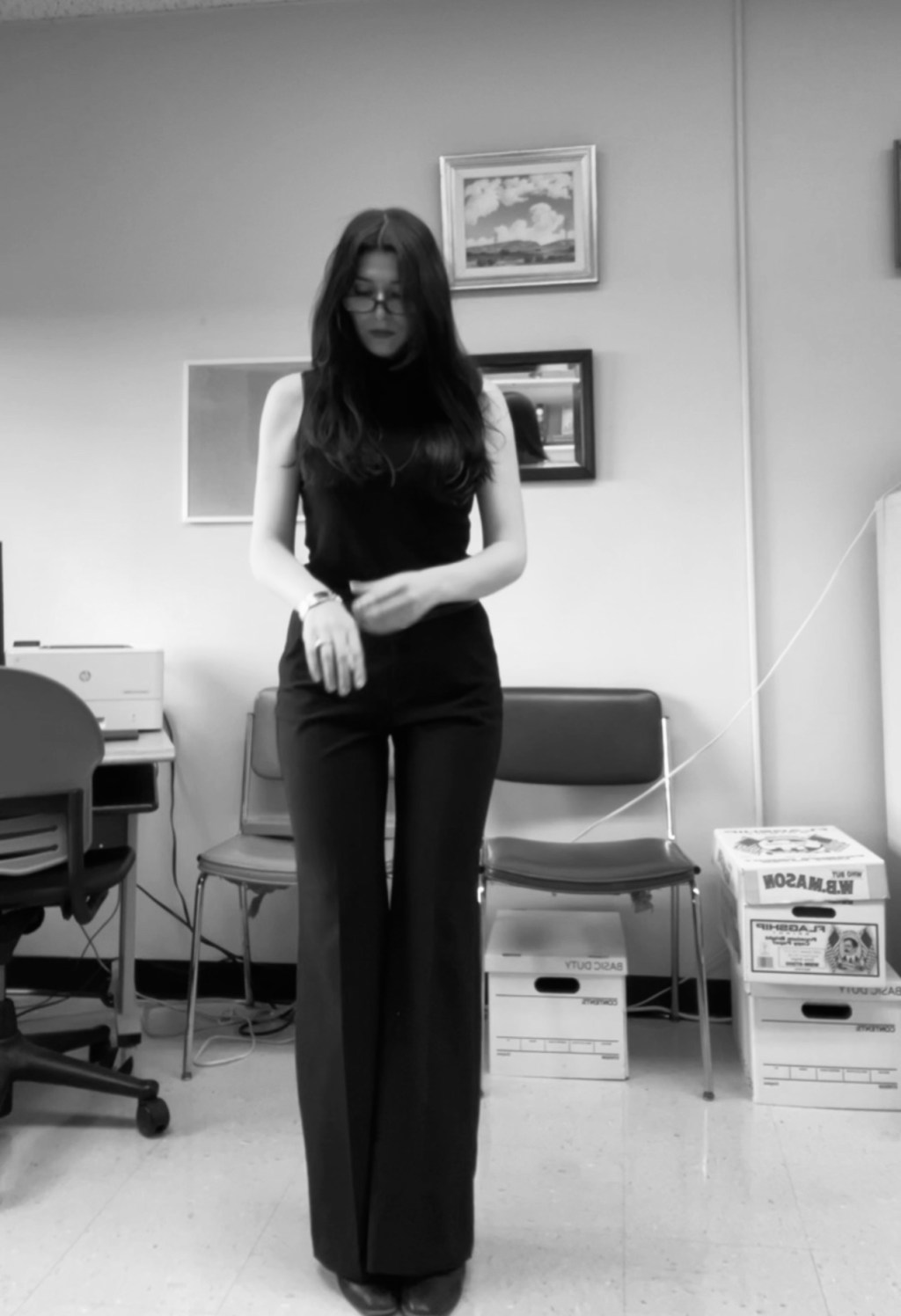
I don’t mean to end on such a dismal outlook, but I wanted to be honest. I know many of my followers romanticize my life as a New York City English professor. It has its moments — I, too, lean into the romanticization to not go completely cuckoo. I love being around academics; I love writing; I love teaching; I love back-to-school shopping; I love fresh notebooks and pens; I love putting together my professor outfits; I love helping young writers find their confidence.
But I wonder, with the growing list of teachers leaving education and the widening “class gap” among our population … if the adjunct professor gig will eventually become the norm for education. I truly hope not.
Cumulatively yours,
That American Girl
 That American Girl
Leave a comment